
Views: 138
More than one hundred people related to cultural heritage and its management from across the State — including professors, PhDs, members of ICOMOS, landscape experts, geographers, architects and museum directors — have signed a statement asking the Island Council of Menorca to halt a project that affects an area declared World Heritage.
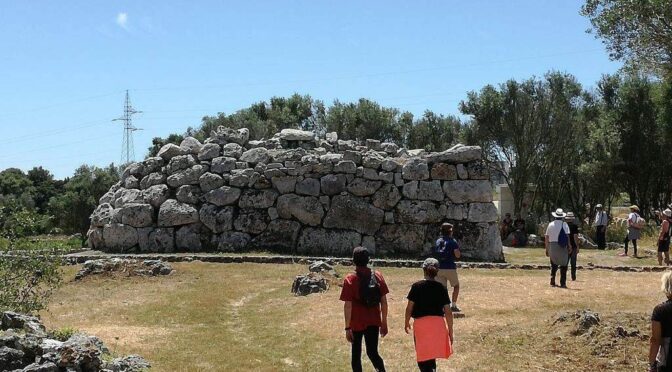
This controversy arises from the intention to build a two-level roundabout at the Rafal Rubí junction, in the eastern part of the island and next to an archaeological site where, in 2013, work began but was halted due to the withdrawal of the contract. During this time, Menorca applied to be declared World Heritage because of its valuable Talayotic legacy, and UNESCO already requested that the half-built junction be removed because it constituted a very significant alteration of the landscape of one of the protected areas included in the candidacy. This request was explicitly repeated when Menorca received the World Heritage designation in September 2023.
But the current governing team of the Island Council has announced that it intends to complete the large infrastructure, which has reactivated the controversy. This past November, UNESCO stated its position very clearly: it considers that the proposal to finish the two-level structure would have an extremely negative visual impact because it would further affect the integrity and authenticity of the landscape that forms part of the World Heritage area.
Those who have spoken out in this regard are UNESCO and its advisory body, ICOMOS. Despite this position, the Island Council has announced that the project will be resumed, and has attempted to present the disagreement as a political confrontation with the Ministry of Culture.
Now, more than one hundred personalities, experts and professionals at the State level linked to the fields of cultural heritage, archaeology and landscape have signed a statement warning:
“It is a serious mistake and an international affront to insist on a path that UNESCO discourages, which is the body that has declared the Talayotic Menorca as World Heritage. The Council has the duty to maintain Menorca’s credibility and to seek a solution that effectively respects the heritage, modifying the project currently in the tendering process.”
The list of signatories includes personalities, experts and professionals from Barcelona, Granada, Valencia, Lleida, Madrid, Seville, Cadiz, Castilla-La Mancha, Salamanca, Valladolid, the Basque Country, Burgos, Málaga, France, the Canary Islands and other places, in addition to people connected to Menorca.
The main road ME-1 has undergone, in recent years, improvements in junctions that are much more heavily used transversally (even by lorries and buses), which have not required a two-level design. To insist on maintaining this option on land declared World Heritage, and to do so against the recommendations of international bodies, is, in the opinion of the signatories, “a lamentable and incomprehensible situation, which can only cause discredit to the leading institution of Menorca, if a consensus solution is not reached that respects the governing institutions of the World Heritage designation and promotes the protection of the heritage of Rafal Rubí, eliminating the bridge and the half-built junction.”
In this way, Menorca, until now an example in cultural management, is seriously called into question.
See the statement and the list of signatories:
RAFAL RUBÍ, THE PRIORITY OF HERITAGE
The local press has echoed the debate around the Rafal Rubí road junction, where the issue of safety has been highlighted. This is a biased perspective, since the first consideration should be whether the junction is necessary, or whether there are conditions that may advise its suppression, without therefore reducing road safety.
Taking for granted that the junction is essential derives from a series of reports drafted by the author of the project himself, Rodrigo del Pozo, in coordination with other engineers such as Ana Fernández, technician of the Mobility Department, warning politicians of possible patrimonial responsibilities if the project was not executed exactly as the original version.
This set of reports halted the previous Government, preventing the demolition of the bridge, and is now used to justify the new position of the Council. However, other factors need to be considered, and disagreement must be expressed with many poorly-founded or false arguments that promote the continuation of the works.
It has not been mentioned that the Council approved the demolition of the Rafal Rubí junction in a report from the Heritage Service dated 21/10/2019, prepared by an internal civil servant, in contrast to the report now commissioned to an external consultant who is not a civil servant. The internal report that has now been drafted was prepared after the external consultant’s report and is entirely based on it.
The aforementioned 2019 report defined the area of landscape interference of the projected bridge between the road workers’ hut, near the petrol station, and the change in gradient towards Maó, an area totally affected by the proposed junction. Therefore, it clarified the need to modify the project.
In contrast, at no time has the possibility of suppressing the Rafal Rubí junction been considered by the current governing team of the Council, as requested by the entities that addressed the Council in 2018, and as seems plausible given the low transversal traffic. The change of direction to avoid left turns crossing lanes could be made, on one hand, through the Argentina junction, and on the other, through a turning point near the Rafal Rubí road towards Maó that must be executed (the current project foresees a turning point near Biniai).
Throughout the process, the active presence of the Councillor for Culture is noticeably lacking, someone who could support the defence of heritage rather than endorse the interests of maximising construction works under the pretext of safety. The inaction of Culture is unjustifiable, especially in light of the Councillor’s attack in the press on the technicians of the World Heritage Centre, making it appear that the central body of ICOMOS is not competent and is being misled by a minister, who is also questioned.
Perhaps the Council has not understood that maintaining a landscape in its natural state does not mean hiding the ‘navetas’ behind a screen of trees that have not been pruned since the interference between the protection of the ‘navetas’ and the projected road was publicly raised. This solution of the vegetal barrier, put into practice for years and included by the external consultant in the favourable report on the junction — drafted at the request of the Mobility Department and not the Heritage Service — is clearly rejected and discredited in the document issued by UNESCO.
We are facing a lamentable and incomprehensible situation, which can only cause discredit to the leading institution of Menorca, if a consensus solution is not reached that respects the governing institutions of the World Heritage designation and promotes the protection of the heritage of Rafal Rubí, eliminating the bridge and the half-built junction.
It is a serious mistake and an international affront to insist on a path that UNESCO discourages, which is the body that has declared Talayotic Menorca as World Heritage. The Council has the duty to maintain the credibility of Menorca and to seek a solution that effectively respects the heritage, modifying the project currently in the tendering process.
List of the undersigned:
- Jordi Nadal, Professor at the University of Barcelona, graduate in Geography and History, specialised in Prehistory, Ancient History and Archaeology.
- Jordi Hernández-Gasch, Archaeologist, PhD in Prehistory, Ancient History and Archaeology.
- Andrés Adroher, Full Professor of Archaeology at the University of Granada.
- Guillem Pérez Jordà, Associate Professor of Archaeology at the University of Valencia.
- Pau Sureda, Archaeologist, Researcher at CSIC – Galicia.
- Francesca Tugores, PhD in Art History and member of ICOMOS.
- Mateu Riera, Archaeologist and PhD in History (UAB). Associate Professor of Archaeology at the Autonomous University of Barcelona.
- Bea Palomar, PhD in Prehistory and Archaeologist at the Son Fornés Museum.
- Cristina Rihuete, Professor of Archaeology at the Autonomous University of Barcelona and Director of the Son Fornés Museum.
- Jaume Coll, Archaeologist and Director of the National Museum of Ceramics.
- Margarita Sánchez Romero, Vice-Rector at the University of Granada and Full Professor of Prehistory.
- Marta Portillo, Archaeologist and Researcher at CSIC.
- Emili Junyent, Emeritus Professor of Prehistory at the University of Lleida.
- Marta Blanco, Archaeologist.
- Javier Rivas, Archaeologist, President of the Archaeology Section of the Official College of Doctors and Graduates in Philosophy and Humanities and in Sciences of the Balearic Islands.
- Felipe Criado-Boado, Archaeologist, Researcher at CSIC, specialist in landscape architecture.
- Javier López-Cachero, Full Professor of Prehistory at the University of Barcelona.
- Cristina Rihuete, Archaeologist, Professor at the Autonomous University of Barcelona. (Nota: apareix dues vegades a la llista original.)
- Maria José Rivas, Archaeologist.
- Miquel Molist, Full Professor of Prehistory at the Autonomous University of Barcelona.
- Vicente Llull, Honorary Full Professor of Prehistory at the Autonomous University of Barcelona.
- Antoni Puig, Archaeologist, PhD in Ancient History and Archaeology.
- Bartomeu Obrador, PhD in Classical Philology and collaborator in archaeological projects.
- Macarena Bustamante, Associate Professor, Department of Prehistory and Archaeology, University of Granada.
- Alberto Dorado, Professor at the University of Granada.
- David Garcia, PhD in History (UAB).
- Octavio Torres, PhD in Archaeology, heritage educator and Associate Professor at the University of Barcelona.
- Joan Carles Alay, Archaeologist.
- Alfred Mauri, PhD in Medieval History.
- Rafael Mata, Full Professor of Geography at the Autonomous University of Madrid.
- Víctor Fernández, Full Professor of Human Geography at the University of Seville and member of ICOMOS.
- Joan Miquel Morey, Cultural manager.
- Enric Taltavull, Architect.
- Jordi Rius, Geographer.
- Eva Alarcon, PhD in Prehistory and Professor at the University of Granada.
- Jordi Amorós, Archaeologist.
- Rocío Da Riva, Full Professor of Prehistory at the University of Barcelona.
- Juan J. López, Archaeologist, Researcher at the University of Granada.
- Enric Costa, Heritage technician.
- Domingo C. Hernández, Master’s degree in Historical Research, Prehistory and Archaeology.
- Ivan Ramos, Doctoral researcher, Master’s degree in Maritime and Underwater Archaeology.
- Mireia Sabaté, Archaeologist, conservator-restorer.
- Luís M. Cobos, Archaeologist.
- Mónica Oliva, Archaeologist.
- Pol Junyent, PhD in Medieval History.
- Lluís Lloveras, Associate Professor, Department of Archaeology, Prehistory and Ancient History, University of Barcelona.
- Ada Quero, Archaeologist, Researcher at the University of Granada.
- Aurora Rivera, PhD in Archaeology, Postdoctoral Researcher at the University of Cadiz.
- Araceli Martín, retired, former Head of Archaeological Protection Areas, Department of Culture – Archaeology and Palaeontology Service, Government of Catalonia.
- Jaume Buxeda, Full Professor of Archaeology, University of Barcelona.
- Xavier Terradas, Professor of Prehistory, CSIC-IMF, Barcelona.
- Carlos Gómez, Full Professor of Archaeology at the University of Valencia.
- Ramón Alvarez, Professor of Archaeology at the University of Barcelona.
- Dídac Roman, Professor of Prehistory at the Jaume I University.
- Silvia Albizuri, Archaeozoology researcher.
- Cristian Emens, Lecturer in Archaeology at the University of Barcelona.
- M. Carmen Cañizares, PhD in Geography and Professor of Spatial Planning at the University of Castilla–La Mancha.
- M. Cruz Porcal, PhD in Geography, Associate Professor of Human Geography, University of the Basque Country.
- Rocío Silva, Full Professor of Human Geography, University of Seville.
- Juan Ignacio Plaza, Full Professor of Human Geography, University of Salamanca.
- Jorge Hermosilla, Full Professor of Geography, University of Valencia.
- Ángel Raúl Ruiz, Researcher and Lecturer at the University of Castilla–La Mancha, Department of Geography and Spatial Planning.
- Elvira González, Art historian and archaeologist.
- Guillem X. Pons, Professor of Geography, University of the Balearic Islands.
- Rafael Micó, Full Professor of Archaeology at the Autonomous University of Barcelona.
- Ismael Moll, Professor, graduate in History and archaeologist.
- Eugenio Baraja, Professor of Geography, University of Valladolid.
- Marta Martínez, Professor of Geography, University of Burgos.
- Paula Sánchez, Archaeologist.
- Nieves López, Professor of Geography, Autonomous University of Madrid.
- Jordi Morera, PhD Archaeologist.
- Antoni López, Archaeologist.
- Ma. Àngels Hernández, Art historian.
- Roser Pérez, Archaeologist.
- Margarita Orfila, Full Professor of Classical Archaeology.
- Enric Soria, Architect.
- Damià Gomis, Full Professor of Earth Physics, University of the Balearic Islands.
- Ferran Vizoso, Architect.
- Jordi Garcés, Architect.
- Alfons Méndez, PhD in Economic History, University of the Balearic Islands.
- Javier Clarós, Architect.
- Òscar Trullàs, Archaeologist.
- Maria Engracia Muñoz, PhD in Archaeology and Science Communicator.
- Magdalena Salas, Archaeologist and Director of the Museum of History of Manacor.
- Ramon Coll, Archaeologist.
- Matías Mérida, Full Professor of Geographical Analysis, University of Málaga.
- Cecília Ligero, Conservator–Restorer of Archaeological Heritage.
- Carmen Lara, Archaeologist.
- Cristina Bravo, Archaeologist.
- Cristina Andreu, Art Historian.
- Irene Riudavets, Archaeologist.
- Joaquim Pons, PhD in Prehistoric Archaeology.
- Montserrat Anglada, Archaeologist.
- Núria Rafel Fontanals, Archaeologist and retired Lecturer at the University of Lleida.
- Cristina Rita Larrucea, Archaeologist.
- Núria Villena, Anthropologist and Researcher at the French National Institute for Preventive Archaeological Research (INRAP).
- Carmela Sánchez Gómez, Architect.
- Antoni Ferrer, Archaeologist.
- Carlos Santana, Archaeologist.
- Mónica Luengo, Art Historian and Specialist in Cultural Landscapes.
- Xosé Santiago, Architect.
- Lydia Adalid Villar, PhD in Ancient History.
- Germán Aguilar, Historian and Architect.
- Andrés Curràs, PhD in History, Archaeologist at the Max Planck Institute of Geoanthropology (Jena).
- Ana Maria Santorum, World Heritage Manager, Tower of Hercules.