Views: 54
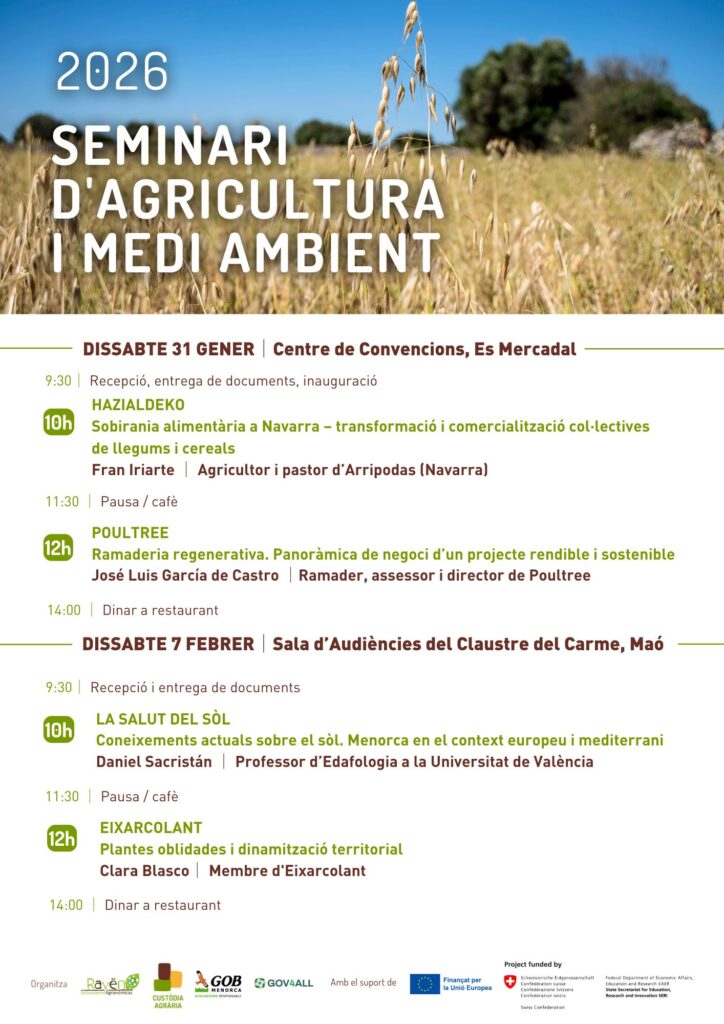
Scientific knowledge, practical experiences and innovative models to promote more sustainable agriculture are the core of the programme of the nineteenth edition of the Agriculture and Environment Seminar. The sessions, to be held on 31 January in Es Mercadal (Convention Centre) and on 7 February in Maó (Audience Hall of the Claustre del Carme), will allow attendees to delve into topics such as the collective processing of organic pulses and cereals for food sovereignty, regenerative livestock farming, the state and management of soils, and the recovery of wild plants and traditional agricultural varieties.
The seminar lectures will bring together field experiences and real-life examples, through which participants will discover innovative strategies to foster sector resilience in multiple ways. For example, by strengthening short marketing channels, improving soil health and promoting more ethical and balanced agri-food models. Registration is now open.
The first lecture, “Food sovereignty in Navarre – collective processing and marketing of pulses and cereals”, will be delivered by Francisco Iriarte, a farmer and shepherd from Navarre. Iriarte belongs to Hazialdeko, an association of organic extensive-crop producers in Navarre that promotes a collective model for the production and marketing of locally sourced organic cereals, pulses and feed. Its aim is to strengthen farmers’ bargaining power and access to processing services and local markets, foster agroecology and social, environmental and economic sustainability, and consolidate trust-based relationships within short marketing channels.
The first session will close with José Luis García de Castro, livestock farmer, consultant and director of Poultree, with “Regenerative livestock farming. Business overview of a profitable and sustainable project”. García de Castro will offer an insider’s view based on the experience of his regenerative livestock company, founded in 2019 in Extremadura. Poultree focuses on rearing chickens and cattle entirely fed in rotational grazing systems. This livestock production model integrates animal welfare, ecosystem health and human health through management practices that enhance soil health, increasing both organic matter content and the capacity to capture carbon and retain water. This type of management enables climate change mitigation in soils and a more balanced and sustainable functioning of the agricultural–environmental–human system.
Daniel Sacristán, Professor of Soil Science at the University of Valencia, will open the second day with “Current knowledge on soils. Menorca in the European and Mediterranean context”, offering an up-to-date overview of soil status: what is measured to understand soil quality, what knowledge has been gained and which technologies are applied to study it. The presentation will place the reality of Menorca’s soils within the national and European framework and address practical implications for the agricultural sector. It will include a summary of results from the carbon capture study monitored by the University of Valencia on farms participating in the Custòdia Agrària programme on the island.
The final lecture, “Forgotten plants and territorial revitalisation”, will be delivered by Clara Blasco, a member of Eixarcolant. Eixarcolant is a non-profit collective working on the recovery and valorisation of edible wild plants and traditional agricultural varieties, with the ultimate goal of promoting a sustainable food model. The collective develops projects in applied research, territorial revitalisation, outreach, training and advisory services.
Those interested in learning how to commit to more sustainable agriculture can register by completing the registration form. You can also email us at custodia@gobmenorca.com, or call 971 350 762.
The registration fee includes lunch. The fee is €25 for both days and €15 for one day only, with discounts for producers with custody agreements, volunteers and members of GOB Menorca. The seminar is organised by Rayën Soluciones Agronómicas and the Custòdia Agrària programme of GOB Menorca, within the GOV4ALL project, funded by the European Union’s Horizon Programme.