Views: 15
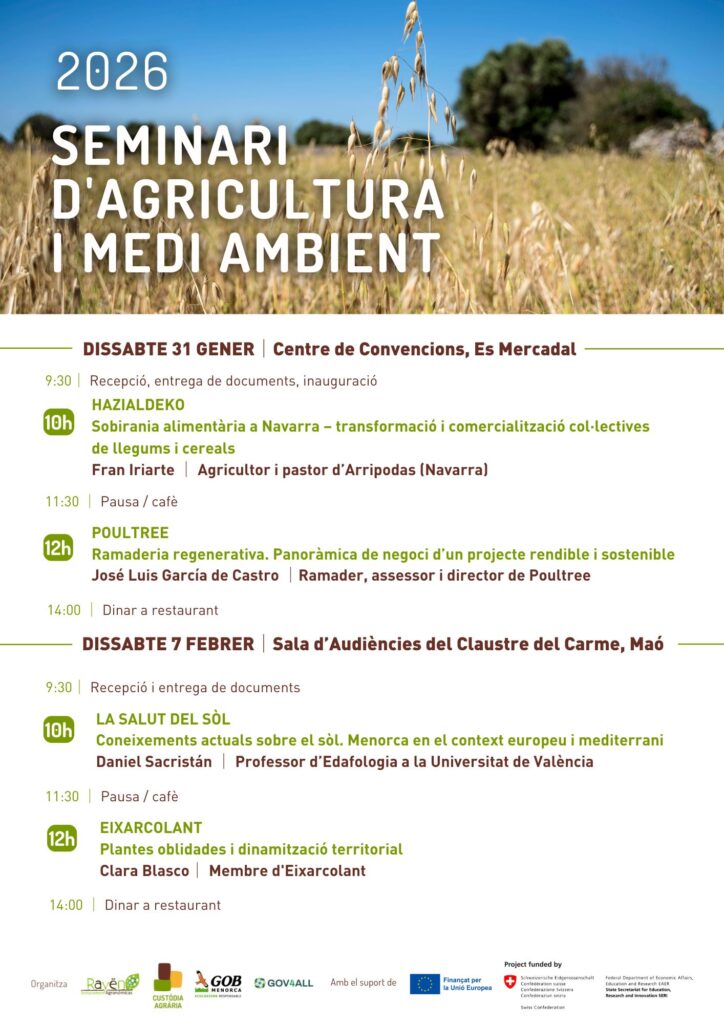
The final session of the 2026 Agriculture and Environment Seminar, to be held in the audience hall of the Claustre del Carme on 7 February in Maó, will focus on the role of knowledge — scientific, traditional and applied — as a driver of transformation in the agricultural model. The presentations will address, from complementary perspectives, how recent advances in the study and management of soil, on the one hand, and, on the other, the recovery of wild edible plants and traditional varieties, can contribute to strengthening biodiversity, food sovereignty and the economic viability of the primary sector.
Two presentations that will outline a horizon in which research, farming and territory converge to move towards a more sustainable, resilient and locally rooted agriculture through concrete and contextualised experiences and data.
The day’s presentations
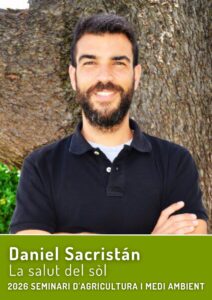 Daniel Sacristán is a Professor of Soil Science at the University of Valencia, where, in addition to teaching, he conducts research on soil health, biodiversity and the sustainability of Mediterranean agroecosystems, participating in national and European competitive projects. In his presentation, entitled “Current Knowledge on Soil. Menorca in the European and Mediterranean Context”, Sacristán will present the current state of knowledge and research on soil and explain the impact of recent advances on farmers’ day-to-day management.
The session will place the available data on Menorca’s soils within the national and European framework and will present the results of the carbon capture study carried out on farms under the Custòdia Agrària programme on the island. The perspective will be completed with a look at reference initiatives and tools at European level, such as the Joint Research Centre and mapping and artificial intelligence platforms such as OpenLandMap and AI4SoilHealth, which provide key data to move towards more sustainable and resilient agriculture.
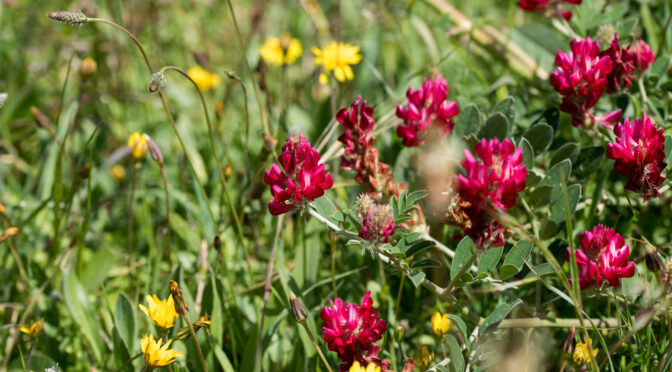
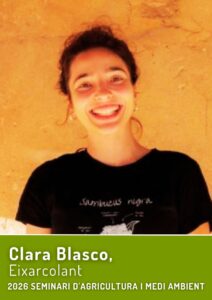 An environmental scientist specialised in agroecology and territorial management, Clara Blasco has linked her professional career to the study and promotion of agro-environmental practices that integrate scientific knowledge and practical applications for the transition towards more sustainable and resilient agricultural systems. Blasco is coordinator of the Catalan collective Eixarcolant, which works to recover knowledge and uses of botanical and cultural heritage in order to make them accessible and useful for society. They work to recover thousands of wild species and traditional varieties that have practically disappeared, even though we very often have them close at hand.
Her lecture, “Forgotten Plants and Territorial Revitalisation”, will focus on explaining how the conservation and rediscovery of wild edible plants and traditional agricultural varieties can promote agroecology, food sovereignty and sustainable rural development. Drawing on the experience of Eixarcolant, she will present ethnobotanical recovery projects that are key to revaluing forgotten species and practices, strengthening agricultural diversity and offering new productive and economic opportunities.
The price for this final session of the seminar is €15. Discounts are available for producers of farms with stewardship agreements, participants in the volunteer programme and members of GOB. The price includes lunch. It is still possible to register for the session through the registration form.
The 2026 Agriculture and Environment Seminar is organised by Rayën Soluciones Agronómicas and the Custòdia Agrària programme of GOB Menorca, with the support of the European Union’s GOV4ALL initiative.