
Views: 63
The theory of no man’s land began as a somewhat rudimentary slogan, but it soon took root because of the usefulness it could offer at particular moments. Circumstances condition many things. When more developed societies carried out the occupation of other territories, it was necessary to dress it up with justification.
The strategy was to argue that no one was using that land. Without ploughing or sowing, it seemed abandoned. It was not difficult to spread the idea of lands that held no interest for those who had arrived previously. A line of reasoning that was very successful, to the misfortune of those who were already living there.
Claiming spaces in the new colonies under the figure of unoccupied lands allowed the conquering State to occupy them with legal cover (of its own laws, of course) and distribute them among the newcomers, who had come precisely to colonise.
Among the spaces that suffered these assaults were the great North American plains. There, millions of bison — the largest bovine on that continent — grazed naturally. Native people obtained many resources by hunting these animals. The land was not sown by human hands, but it was managed through grazing by the wild herds themselves.
Eliminating the bison was one of the colonial strategies, as it removed the main food base of the peoples who were to be subjugated. The hunting was brutal and disturbing. Vast plains were left without animals. It was the no man’s land that the newcomers awarded to themselves.
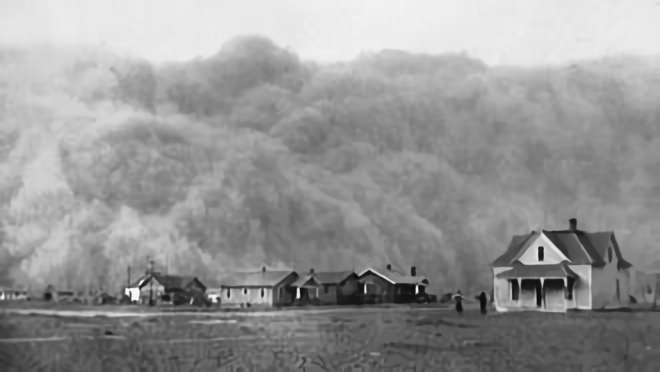
The enormous American prairies were later ploughed to produce cereals. Without adapted plants and combined with considerable drought, in the 1930s millions of hectares turned into immense dust storms that rose with the wind. There were catastrophic environmental episodes and widespread respiratory diseases. Hunger and migration ensued.
After the harsh lesson, trees and wild vegetation were planted, ploughing was reduced and water management improved. This generated a mosaic landscape that may vaguely recall that of Menorca.
In Menorca, in the 1970s and 1980s, the argument of poor land was used to justify its allocation to real estate uses. The process was halted by significant social mobilisation calling for a different model for the island, which eventually translated into land-use planning that preserves rural land for agricultural activities.
But nothing lasts forever and now new offensives are underway which, ornamented with different discourses, push farmers out of rural land. Tourist rentals in the countryside, currently not permitted in Menorca but among the proposed modifications, would encourage the expulsion of farmers because renting houses to tourists is more profitable.
There are also attempts to eliminate the current obligation to reserve a percentage of existing buildings for agricultural uses when establishing agritourism businesses. Without support buildings, only small-scale agricultural management is possible. The land remains without production and enters the category of space desired for other uses.
Defending territory also means thinking about what uses it can be given. The American case shows that no man’s land is dangerous and that exploitation without precaution can turn catastrophic.
(This text is an adaptation of the original article published by Miquel Camps, as coordinator of territorial policy for the GOB, in the Menorca newspaper on 16/02/2026).