
Views: 0
In recent years, students’ right to take part in activities outside the classroom has been facing an obstacle as unexpected as it is insurmountable: the prohibitive cost of discretionary transport services.
Far from being a luxury, school trips are fundamental pedagogical tools and form part of the comprehensive development of the educational curriculum. It must be explicitly acknowledged that these activities are part of the right to education with equal opportunities and cannot be considered optional complementary activities. In fact, for many children, these excursions represent the only opportunity to get to know their natural surroundings, as their daily lives are confined to city streets or, worse still, to the walls of their homes.
Transport prices have risen so sharply that the cost of the bus doubles and even triples the price of the activity itself. According to the reality reported by numerous educational centres, this situation has led to a significant reduction in the number of school trips in recent years, with many centres stopping outdoor activities altogether. This creates clear inequality, as only students with greater purchasing power can access these experiences.
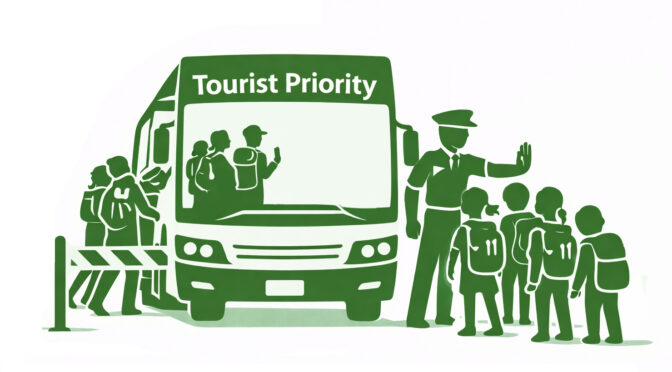
This situation is particularly aggravated between April and September, during peak season, when the tourism sector is prioritised by transport companies. This prioritisation highlights a structural imbalance in the economic model, in which educational needs are subordinated to tourism activity. This has led, for example, to school groups being taken to the places where the activity or itinerary was to take place and then no bus returning to collect them, or to centres having to cancel activities because they could not find any company with availability. Moreover, all too often it is the companies that determine the timetable for the activity contracted by the educational centre, in order to maximise the number of services in a single day. This reduces the time scheduled to carry out the activity as planned, lowers its quality and has a direct impact on the experience of children and young people.
For years, GOB’s environmental education areas have been offering a programme of activities to discover the nearby environment. Whenever possible, we encourage educational centres to come on foot or by public transport, but there are centres which, due to their location, have to hire private transport in order to go on trips, and there are areas that can currently only be reached by private transport.
We cannot allow the purchasing power of an educational community to determine whether a student can take part in an itinerary, visit or activity outside the school. Education cannot remain confined within four walls due to a lack of logistical resources.
We consider it essential for public administrations to adopt urgent and structural measures: to establish a regulated educational fare for non-compulsory school transport services, setting affordable maximum prices for educational centres; to guarantee a minimum quota of coaches allocated to educational centres, especially during peak season; to create a protected calendar ensuring the availability of school transport during months of highest tourist demand; to promote direct public subsidies to offset the additional transport costs of school trips; to establish centralised public procurement mechanisms to negotiate fair fares and avoid speculative practices; and to strengthen and adapt public transport so that it becomes a real alternative for educational activities, especially on routes of pedagogical interest.
Furthermore, from an environmental and territorial perspective, it is necessary to promote a more sustainable mobility model that includes planning nearby outings and integrating public transport into educational activities, thereby reducing dependence on discretionary transport and pressure on the territory.
We understand that this problem requires a collective response. Therefore, we consider it essential to involve the entire educational community—schools, families and teachers—to generate a shared demand and strengthen advocacy towards public administrations.
Leaving the school is learning to live in the world. We cannot allow fuel prices and excessive fares to condition this opportunity.
For all these reasons, the GOB (GOB Menorca, GOB Mallorca and GEN-GOB) request an urgent meeting with the competent administrations and urge the implementation of these measures before the start of the next school year.