
Views: 94
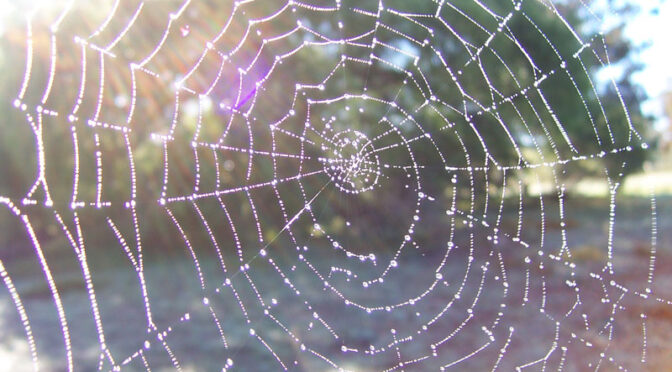
It has calculated the space well. It must be enough for its needs, but not excessively large so it cannot cope with the work. It will first make the spokes that radiate from the centre of the imagined circumference, and then join them with increasingly closer segments.
It has the wax in liquid form inside its abdomen and will extract it so that, when in contact with the air, it becomes an elastic, sticky and resistant material. It will build a barely visible mesh to trap insects.
But it cannot make mistakes with the dimensions. If the covered area is too small, it risks not catching enough food. If the area of the web exceeds the measurements, the spider may run out of material, weaken and die. Having the right measure is key.
Kate Raworth, the economist who redesigned growth theory based on the doughnut figure, explains this matter of dimensions very well. She illustrates it with two concentric circles (hence the similarity to the doughnut). The inner circle symbolizes the minimum economy, which must be large enough to include the requirements for a dignified life, while the outer circle marks the maximum economy, so as not to enter serious problems.
In the case of our spider, the inner circle means that it must generate a web large enough to catch enough food. If it makes the web too small, it will starve. When we speak of the human economy, this area must include basic services such as food, water, housing, education, health, peace… It makes complete sense to grow the economy when it is to cover essential needs.
But the outer circle tells us that we cannot grow infinitely. For the spider, trying to make a web that is too large would exhaust its own reserves. In our societies, unlimited economic growth is causing the climate to change, aquifers to be depleted, or for us to be poisoned by plastic components.
Having clear limits is the first step. Then we can talk about the services we want to enable. An architect first defines how many people will use a building and then decides how many lifts, bathrooms and emergency exits there must be.
When the Alhambra of Granada became the most visited monument in the entire State, it was decided to limit the number of daily entries instead of expanding bathrooms or opening more doors. Menorca is our Alhambra, and the debate we have is whether to apply containment in the number of visitors or to continue expanding services that increasingly degrade our originality.
Reducing tourist promotion or setting a maximum number of tourist vehicles are potential measures in this sense.
Some of the excesses we are committing on the island are already affecting the basic needs of the population. If we irresponsibly drain the aquifers in summer, we will (and do) have problems supplying quality water to the resident population. If we allow housing to be only a market commodity, we will (and are) leaving people without a home.
First the limits, then the services. Nature always serves as an example.
(This text is an adaptation of the original article published by Miquel Camps, as coordinator of territorial policy for the GOB, in the Menorca newspaper on 08/09/2025).