
Views: 147
The Balearic Islands are territories heavily strained by tourist saturation. Menorca, which had been the island most shielded from this dynamic, has again broken records in the number of annual tourists (exceeding 1.7 million). Meanwhile, public money continues to be invested in tourism promotion, and there is no news of any limitation on tourist vehicles for the coming summer.
In this context, in which protests against growing overcrowding and its effects on the islands are multiplying, the Balearic Government has travelled to Europe to present the Opinion “For sustainable and resilient tourism in the European Union”, with which the Balearic Islands seek to position themselves as a political benchmark in tourism matters.
The platforms Canviem el Rumb of Eivissa and Formentera, Menys Turisme Més Vida of Mallorca and Via Menorca warn that the European Opinion on Tourism avoids addressing the root of the problem: saturation and the consequences of touristification on residents, territories and their resources. The organisations recall that these issues require concrete measures, not just discourse.
Europe acknowledges the impacts, but does not dare state what is obvious: we cannot continue to grow.
The document continues to propose well-known formulas —digitalisation, “smart” management, market diversification, seasonality reduction— which, according to the organisations, do not solve the problem but amplify it.
In Menorca it is clear that the goal of reducing seasonality does not mean lowering summer volume. It simply means adding tourism in winter. Without measures that reduce the saturation experienced in July and August, the result is an increase in annual human pressure.
The organisations point out that any truly sustainable strategy must address ecological limits, which are especially evident in island territories, particularly regarding water and energy consumption, road network capacity, erosion, growth of the floating population and the displacement of residents caused by tourist housing.
If Europe wants to talk about sustainability, it must acknowledge limits
The three platforms consider it essential that European institutions incorporate into the political agenda measures that the Opinion does not include. Their demands are:
- Explicit recognition of the ecological and social limits of the islands.
- Tourist decongestion plans in saturated territories, including an actual reduction in places. Cases like the renovation of the Son Bou hotels should result in a substantial decrease. Urban developments planning to add hundreds of villas and hotel beds should be reconsidered.
- Moratoriums on the creation of new tourist accommodation. The latest study drafted by the Island Council for Menorca suggests adding 24,000 more tourist places.
- Regulation of air transport and cruise traffic, key drivers of overcrowding.
- A plan for the progressive reduction of tourism promotion funded with public money.
- Measures to limit summer saturation. Limitation of the number of tourist vehicles. Menorca has had the legal ability to implement this for two and a half years.
- Binding indicators on the right to housing and effective policies against speculation and the tourist commodification of homes to prevent residents from being pushed out. One third of the declared tourist places in Menorca are in housing, and many undeclared places also are.
- Real, not rhetorical, economic diversification aimed at reducing structural dependencies.
Without these measures, the organisations state, the Opinion “makes the discourse more sustainable, but not the model”.
The Balearic Islands are an example of overcrowding
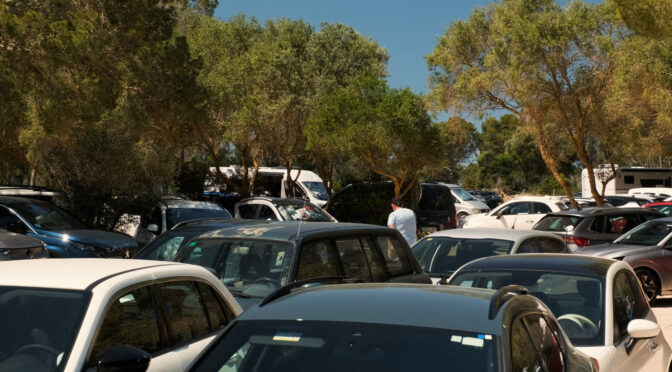
The organisations warn that the Opinion prioritises tourist competitiveness over people’s wellbeing, perpetuating a model that has already shown its limits in the Islands: aquifer depletion, overcrowded beach parking, declining biodiversity, unaffordable housing and a population increasingly expelled from the spaces it inhabits.
For the organisations, the debate is not how to manage more tourists, but how to reduce their volume to levels compatible with life. Looking at the tourist flows in the Balearic Islands (around 19 million in 2024) makes it clear that, for now, they are a laboratory of overcrowding, not of sustainability.
The organisations call on European institutions not to use the Opinion to justify continuing to deepen a model that pushes territories to the limit, and to promote a real agenda for change based on reducing tourist saturation and fostering ecological and social restoration.