
Views: 59
The construction of railways in North America was crucial to the colonisation of territories disputed with Indigenous tribes. The railway line that eventually connected east and west enabled the movement of goods, people and animals. It became one of the key elements in the transformation of those lands—a structural change that meant the definitive colonisation of Indigenous territories.
But there is no need to cross oceans to understand the relationship between infrastructure and its consequences for the places it connects. When land was still being subdivided in the countryside of Menorca, there was always some councillor pushing to pave rural roads in order to facilitate subsequent operations of parcelling and construction.
On the neighbouring island, where building on rural land is becoming a true devastation of landscapes and identity, the link between roads and speculative urban development can again be observed. Wherever major interventions have been carried out on connecting routes (such as the Llucmajor–Campos highway), real estate operations are sweeping away more natural areas.
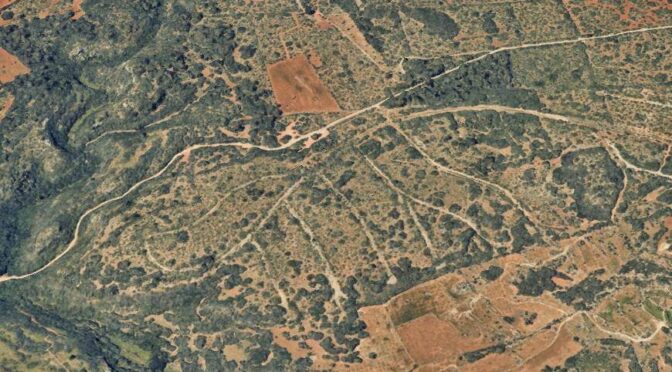
In Menorca, aerial photographs reveal severe scars from past urbanisation attempts that never fully materialised—spaces that are protected today but once hung by a thread. Along the coastline between Binimel·là and Cala Mica, there are still roads where hundreds of villas, three hotels and a quaint fishing village were once planned.
A little further south, the tracks opened at Sa Roca are still visible, with rigid right-angled layouts entirely detached from the terrain, recalling the boundaries of colonial Africa.
East of Son Bou lies the entire road network opened for the Llucalari development, which remained contentious until the 1990s. One can also see the tracks above Calescoves at Lloc Nou. More widely known are the cases of Albufera des Grau and Tirant.
Many of these areas were under threat until the end of the century. The companies and shareholders behind them pulled strings in many official offices. In the end, conservation won the battle.
Over the years and through the different evolutions of each place, it is also interesting to observe how opinions, institutions and markets have reacted. In Mallorca, the first wealthy newcomers who began building villas in the countryside were applauded, as they had fallen in love with the island and spent generously.
Today, the Mallorcan countryside is seen as a vast real estate plot to be carved up. Investment funds buy entire estates, slice them into pieces and build identical packages of villas with pools and gardens, like photocopies. Almost all are destined for uncontrolled tourist use. The market moves fast when there are no limits.
Yet there are still voices claiming this is economy and wellbeing. In Menorca, similar opinions also exist, striving to prevent people from seeing the link between overcrowding and the loss of quality of life.
At Rafal Rubí, a grade-separated junction is being built in a place with no residential nucleus and minimal cross traffic. In a few years’ time, the reasons—perhaps not confessable today—behind this exaggerated project will likely become clear.
(This text is an adaptation of the original article published by Miquel Camps, as coordinator of territorial policy for the GOB, in the Menorca newspaper on 27/04/2025).