Views: 51
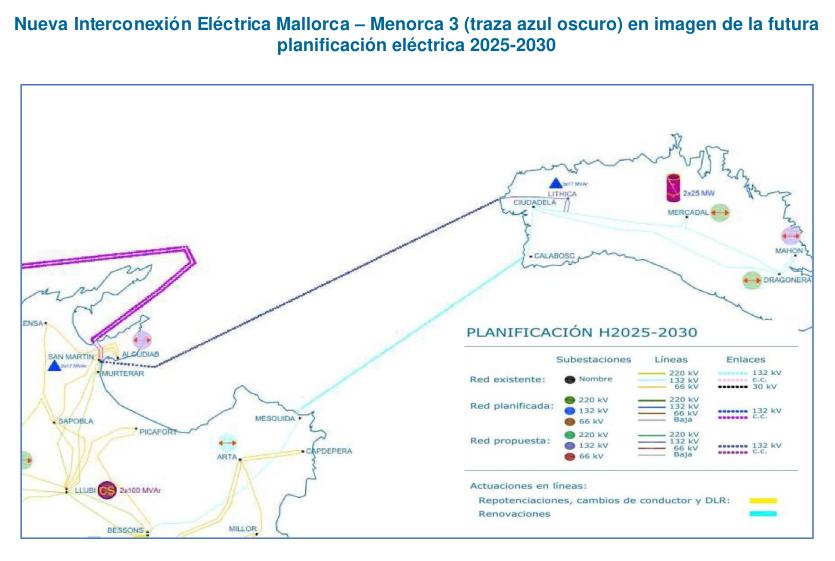
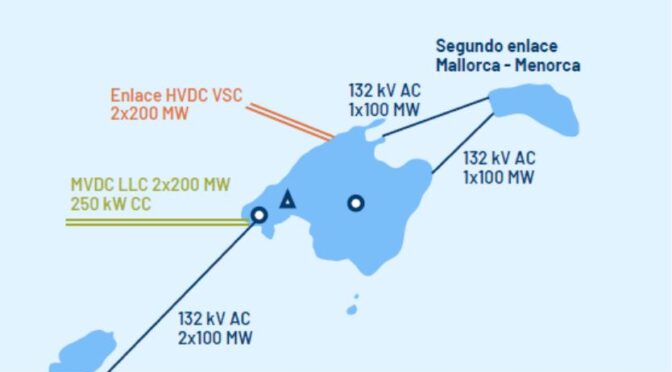
The recent announcement of a second electricity interconnection cable between Menorca and Mallorca raises several concerns regarding the effect it may have on the energy transition of our island, in addition to the environmental impacts that may be generated along its route. The GOB has submitted objections during the public consultation period.
The problem of surplus solar renewable energy during hours of peak sunshine, which Menorca’s demand cannot always absorb, is well understood. Faced with this situation, the institutional proposal is to install a second cable to facilitate the export of surplus renewable energy to Mallorca. However, it should not be overlooked that the objective of the energy transition in Menorca is to reduce the operating hours of the thermal power plant.
The Menorca 2030 Strategy was developed with broad social consensus and with the aim of gradually reducing the volume of fossil fuels currently being burned on the island. The main source of atmospheric pollution (responsible for nearly 50% of Menorca’s CO₂ emissions) is the power plant, whose operation should be limited to parameters that serve as regulatory backup. At the same time, there is still a need to transition land transport, cooking systems and climate control appliances in buildings to other energy models.
The Mercadal battery facility
The second cable is being announced while a large battery storage facility with a capacity of 50 MW is under construction next to the Es Mercadal electrical substation.
This battery facility, presented as one of the largest in Southern Europe, is intended to provide permanent storage capacity to guarantee the operation of the electricity system in the event of any failure affecting an element of the energy transmission network.
It may also allow an increase in the service level of the existing cable connecting the two islands. However, it is explicitly ruled out that it could be used to manage energy flows or network congestion. Therefore, it cannot be used to store surplus solar energy during the day and release it in the evening, as might initially be assumed.
The batteries were announced at a time when it had been agreed not to install a second cable for the time being. The project report for the batteries states literally:
“It is important to remember that the proposed measure of installing the batteries covered by this resolution represents a more economically efficient action than installing a new cable, while achieving the same objective of increasing energy exchanges between the mainland electricity system and the Balearic system and between the different electricity subsystems.”
Will the operation of Menorca’s power plant be reduced?
The main objective of the energy transition in Menorca, which at the time received broad support from institutions, organisations and companies on the island, is to reduce the operation of the power plant, which burns diesel fuel and represents the main source of atmospheric pollution on the island.
In this regard, it seems clear that the second cable can help improve connection security and also provide an outlet to Mallorca for surplus photovoltaic generation that inevitably occurs at certain times of the year. However, institutions should ensure that, in the long term, most of these surpluses can be stored or used directly in Menorca.
The concern is that new electricity transmission infrastructure may end up encouraging Menorca to export energy instead of reducing the island’s pollutant emission levels. Such a scenario, if it is to occur, would require an important prior public debate that has not taken place.
Environmental impacts along the route of the second cable
The GOB has also submitted objections warning of certain impacts arising from the proposed marine route of the second cable. In this regard, it is noted that the project foresees affecting several priority-interest habitats (such as rhodolites, posidonia meadows, coralliferous formations and others) within an area that is also a Site of Community Importance (the Menorca Channel), included among the European protected areas of the Natura 2000 network.
In this context, the GOB has presented the conclusions of various scientific studies warning of the previous failure of environmental regeneration measures that are once again being proposed as if they were effective solutions. This is because some species grow very slowly and therefore the recovery of the habitats they form is not feasible on a human timescale. In such cases, the European Union requires that impacts be compensated not through regeneration actions (which have negligible success) but through the protection of new areas containing the same habitats.
Specific protection has been requested for pen shells, in both existing species, and exhaustive monitoring to prevent leaks of bentonite, the slurry used to consolidate underground drilling. It should be recalled that the works on the Ciutadella desalination plant caused bentonite to spread uncontrollably, eventually covering and seriously degrading a large area of posidonia seagrass meadow.
The GOB also warns that the European Commission requires strong justification of environmental improvements for projects affecting habitats of community interest within the Natura 2000 network, something that is not provided by the documentation made available to the public, which defends the second cable as a safety measure but does not demonstrate its environmental benefits. When there are no environmental improvements, projects must be subject to a prior favourable opinion from the European Commission.