
Views: 29
This note is the second part of a reflection on the relationship between renewable energy and land use. It describes the situation in Menorca, which can be very different from other islands as well as from mainland Spain. For this reason, it is not appropriate to assume that what happens elsewhere is being replicated here, because that is not the case.
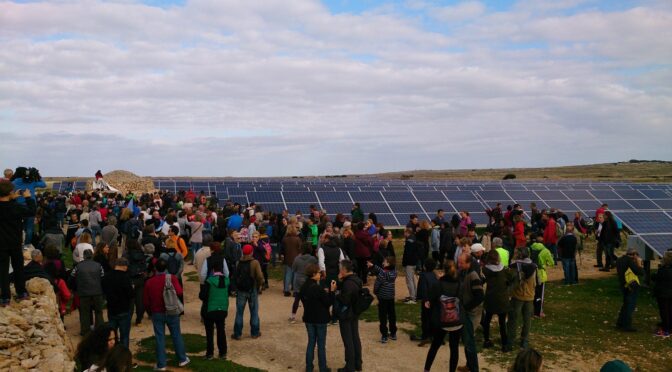
Over the past 20 years, several wind energy projects have been proposed in Menorca but have been halted for environmental reasons. At the same time, significant progress has been made in zoning suitable areas for photovoltaic energy, ensuring that spaces with environmental or landscape protection status are not considered suitable.
Anyone interested in understanding the differences and criteria applied in Menorca is encouraged to read the full text presented here.
The debate on early wind farms
In this discussion, it is clear that wind farms are much more difficult to accept. In our island context, photovoltaic installations can be managed so that they are only visible when you are close to them, but wind turbines are visible from large parts of the island.
Several wind energy projects have been proposed in Menorca, sometimes on a large scale. However, they have never been developed because they were planned in areas of high environmental value, except for the Milà facility, which is the only one that was eventually built.
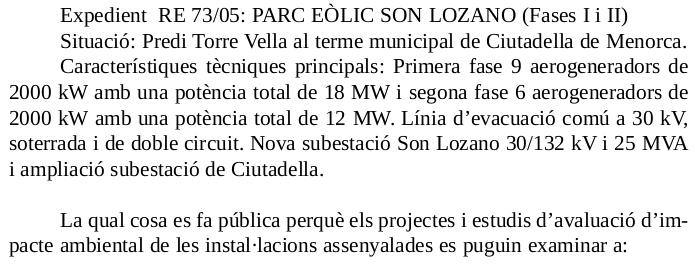
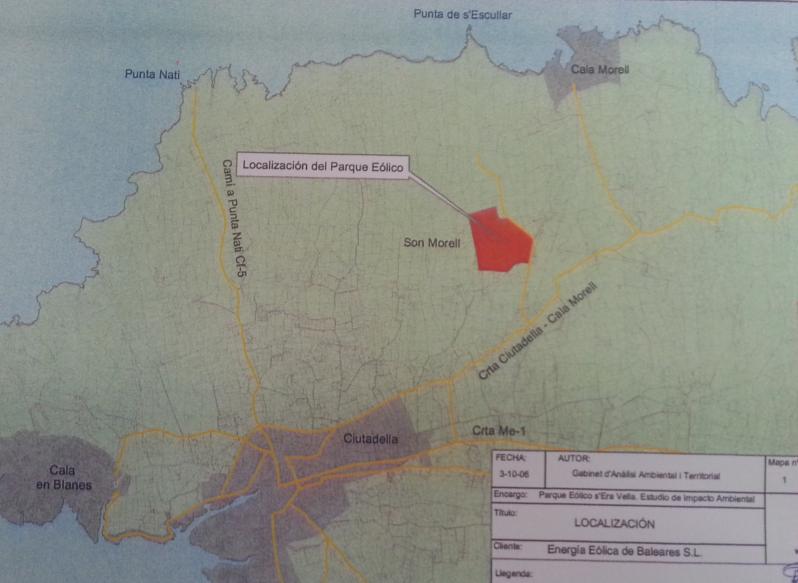
Some people may remember a wave of wind farm proposals promoted by the Balearic Government. Some reached the public consultation stage, such as the Son Lozano project in the north of Ciutadella. The most controversial proposal at the time was the Son Bruc and Ses Comunes project (2006), which covered a large section of the ridge north of Ferreries, included six kilometres of road construction through highly protected ANEI areas, and proposed turbines taller than the island’s highest point, El Toro. Both projects were ultimately rejected.
Years later, new proposals emerged again in the north of Ciutadella, in S’Era Vella and Son Angladó. However, they were poorly designed, as they were located in areas where environmental regulations explicitly prohibited wind farms. Once this was highlighted in objections, the projects were halted.
When there is no public planning, companies tend to seek areas with maximum profitability and minimum costs. In other territories, this has led to interventions in densely forested areas or sites of high environmental value. This has not been the case in Menorca.
From an energy perspective, combining wind and solar power is beneficial, as they produce energy at different times. The Milà site could be one of the few locations with relatively low conflict, although this idea currently appears to be on hold. Offshore wind proposals that have been considered tend to be oversized projects with limited feasibility.
Zoning: a key tool to protect valuable land
For many years, renewable energy planning was treated mainly as a responsibility of energy authorities. In Menorca, however, the Insular Territorial Plan eventually incorporated territorial criteria to determine where renewable energy facilities can or cannot be located.
As a result, the following areas are excluded:
- Landscape Interest Areas
- Territorial Protection Areas
- Rural Landscape Protection Areas
- Environmental Relevance Areas
- Protected Natural Areas (ANEI)
- High Agricultural Value Zones
- Public Hydraulic Domain
- Flood-prone areas
- Geological Interest Sites
- Natura 2000 habitats of community interest
- Forested areas
- Ecological corridors
- Sensitive areas for threatened flora
- Other zones critical for endangered or specially protected species
When all criteria overlap, the most suitable areas for renewables tend to be those close to energy demand centres: outskirts of towns, areas near industrial estates, or zones adjacent to urban developments. Large-scale plants must also connect directly to a substation, which further limits suitable locations.
Construction criteria and reversibility
Early renewable energy plants built in Menorca followed models imported from elsewhere. These involved levelling land, importing external materials, heavy machinery compaction, and large concrete foundations for mounting solar structures. This approach effectively transformed the land into an industrial site.
Negotiations with developers and institutions made it possible to prevent this model and shift towards a less intrusive approach. The goal is that, in 30 years—if new energy systems are available—these installations can be dismantled and the land restored to a condition similar to its original state. Land for renewable energy should be borrowed, not consumed.
These construction principles are also included in territorial planning regulations. If they are violated, they must be reported, as the GOB did in the early stages of the Binifaell project.
When renewables were deliberately slowed down
For several years, renewable energy development was significantly stalled across Spain in what became an international controversy. The so-called “sun tax” penalised self-generation of clean energy, aiming to protect the profits of major electricity companies. This regulation was finally repealed in 2018.
Today, alongside rural solar parks, rooftop self-consumption is growing steadily in Menorca. Early examples of energy communities are also emerging, allowing people to share photovoltaic production even if they do not have suitable roof space.
However, every new renewable installation represents a loss of market share for fossil fuels, reducing the need to purchase them. This has triggered renewed resistance from established energy oligopolies, expressed through various campaigns.
It is also increasingly common to find arguments opposing renewables while supporting nuclear energy, often ignoring that nuclear power produces radioactive waste lasting thousands of years, that accidents can have severe consequences, and that in Spain it is still controlled by the same major electricity companies.
Energy sovereignty: a key concept for the future
On an island, energy autonomy is a crucial strategic issue for the near future. Modern conflicts are increasingly driven by competition over fossil fuel resources, which are becoming scarcer after nearly two centuries of intensive use.
Menorca imports almost all the energy it consumes (aviation kerosene, transport fuels, heating fuels, and diesel for the power plant). Although it is connected to Mallorca via an electricity cable, in the event of a fuel crisis, priority would likely be given to major urban centres rather than islands like Menorca.
Energy sovereignty—like food sovereignty—is a long-term goal that should guide strategic decisions whenever possible.
Above all, the main cross-cutting challenge facing the islands is the ever-increasing human pressure, driven by a tourism model that resists limits. With around 1.7 million tourists in 2025, the demand for labour, water, energy, and waste management continues to grow. Sustainability requires confronting these challenges directly.