Views: 1061
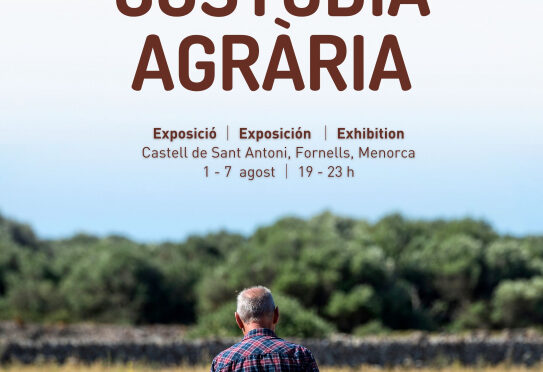
The distinctive features of the Land Stewardship Scheme can be seen in the exhibition now open at the Sant Antoni Fort in Fornells from Monday 1 to Sunday 7 August. Continue reading Land Stewardship Scheme , exhibition at Fornells
Views: 1061
The distinctive features of the Land Stewardship Scheme can be seen in the exhibition now open at the Sant Antoni Fort in Fornells from Monday 1 to Sunday 7 August. Continue reading Land Stewardship Scheme , exhibition at Fornells
Views: 1298
It is noticeable, without paying much attention, that one of the icons of the Menorcan agricultural landscape has been losing its strength and vigor over the last few years. We are referring to the fig tree, this tree of dry land that with very little care was producing golden gifts in the middle of August.
The Land Stewardship Scheme has started a series of initiatives to encourage its restoration. The object is to contribute to the maintenance of the unique landscape that these trees create and, at the same time, diversify produce from those interested farms.
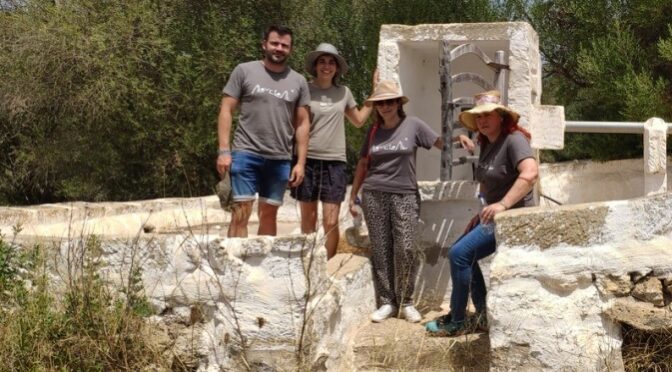
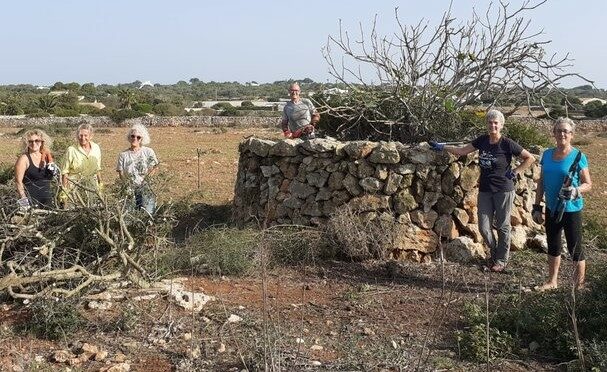
During the last year, through the agricultural days of volunteering, 21 fig tree enclosures have been restored. Volunteer help on the farms has enabled the clearing out of wild olive bushes and brambles that invaded the enclosures, maintaining the dry stone wall structures, pruning fig trees that still had living branches and eliminating those that were completely dead and planting new ones.
Fig trees, amongst other dry wood trees, are planted in the middle of the countryside and dry stonewalls are built round them to protect them from the cattle. However, it is a characteristic to see the animals looking for some fallen figs around the enclosures.
As well as the restoration of some of the enclosures, 120 fig plants have been bought to distribute between the farms. The purchase has been diverse: from the “paratjales” with their distinctive broken red fruit, to the sweetness of the white lady’s neck, through to the bold, first batch of the summer, of the “fig flower” and finishing with the bardissot variety.
The last few years have seen a decline in the figs of Menorca. certainly the effect of climate change and lack of water, combined with no maintenance, are some of the factors that come into play in lowering the crop defences against disease.
Harvest figs again at the end of August to accompany an oliaigua or enjoy the smell of ripe figs. Look for the fresh green leaves in summer or enjoy the simple tastes from a bunch of figs picked in the early morning and eating them fresh from the night. We can retain some of those pleasures if we continue with the restoration of the emblematic fig trees in Menorca.
The agreement between GOB and the farms signed up to the Land Stewardship Scheme gives the farms the option to diversify their products and maintain distinctive landscape features such as the fig tree enclosures. That is only one of the many options that is gained from the mutual benefit between the farms and volunteers each year. Many thanks to all those who took part in the volunteering activities.
The activity has the economic support of the Menorca Island Council, the Menorca Preservation Fund and the MAVA Foundation.

Views: 1118
This Wednesday, 4 May, there is an opportunity to understand the Land Stewardship Scheme programme, what the objectives are, what methods it applies and how it is evolving. Continue reading Wednesday 4 May, talk on the Land Stewardship Scheme at the Ateneu
Views: 1238
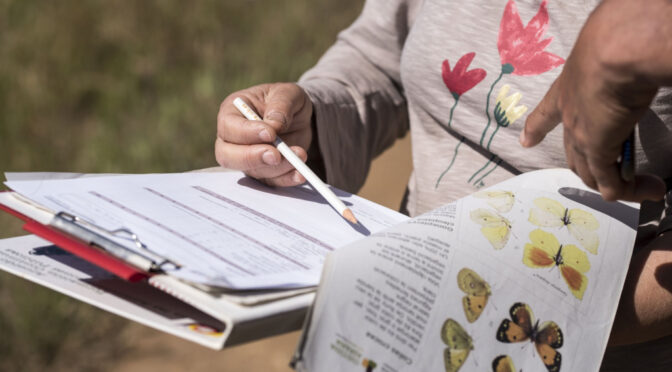
With the current good weather the Menorcan countryside becomes filled with life and colours. Now is the moment to start monitoring the bioindicators on the farms in the Land Stewardship Scheme. Continue reading Environmental richness in the Land Stewardship Scheme farms
Views: 729
The Secretary of the Spanish Committee of the MAB Programme (Man and the Biosphere Programme launched by UNESCO in 1971), Jose Cantos, recently gave us a diploma awarded for GOB’s contribution to the Sustainable Socioeconomic Development of Menorca. It was recorded in the Reserve of the Biosphere Recognitions for Environmental Commitment granted by the Autonomous Agency of National Parks of the Ministry of Ecological Transition.
GOB has received this award “for its participation in multiple sustainable social and economic development projects, in which the Land Stewardship Scheme stands out”. The resolution highlights the large number of people associated with GOB (1,450 members), their participation in many conservation campaigns and in projects that focus on orienting the economy toward sustainability, as well as for the promotion of the Land Stewardship Scheme that includes 34 agricultural farms signed up to the agreement.
The selection of awards for environmental commitment in the Biosphere Reserves analysed 112 candidates and finally granted 17 distinctions. In the case of Menorca, under the heading of Promotion of Environmental Research and Education, the Institute of Menorcan Scientific Studies – OBSAM – was recognised as the driving force behind the declaration of the Reserve of the Biosphere in Menorca and for its scientific monitoring of sustainability indicators.
This recognition at a state level has been received 24 years after Menorca became a Reserve of the Biosphere, and adds to the international prize that GOB received in those first years. That award was given in 1997, by TUI International that wanted to honour the active contribution by GOB for making the Reserve of the Biosphere a reality and not just an honorific title.
Views: 258
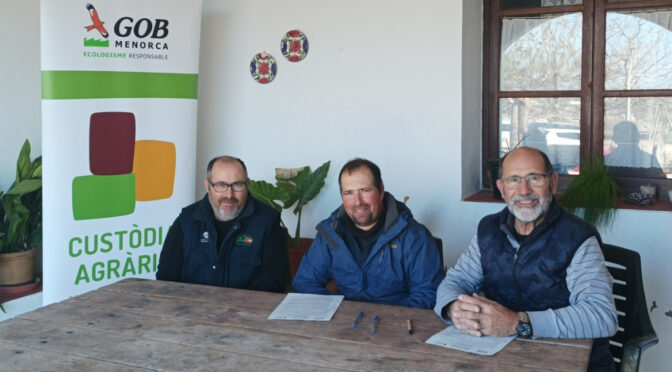
The Land Stewardship Scheme celebrates the incorporation of a new member. By signing the agreement for sustainable farming practices, the s’Alblagai farm has joined the network of farms committed to an agricultural model that is economically viable and respectful to nature. Continue reading S’Alblagai becomes a member of the Land Stewardship Scheme
Views: 1005
The third round table discussion on projects that are eligible for the European Next Generation funding will be on Menorcan countryside projects. It will take place on Thursday 17 February at 20h at the Mahon Ateneu and can also be followed on your canal youtube Continue reading Projects on the rural world to be debated on Thursday 17 at the Ateneu
Views: 771
GOB has received a distinction from the Ministry of Ecological Transition for its contribution to the economic and social sustainability of the Reserve of the Biosphere of Menorca. Continue reading GOB receives a state prize for its contribution to the Reserve of the Biosphere
Views: 750
For the Christmas Season we are selling gift baskets of local items, with the added value of being sustainably produced, going much further than our table. You can personalise the contents or choose one of the three options pictured above. They make a perfect choice for a healthy and natural gift that brings a closeness to friends, family or business. Continue reading Hampers of Land Stewardship Scheme products
Views: 1156
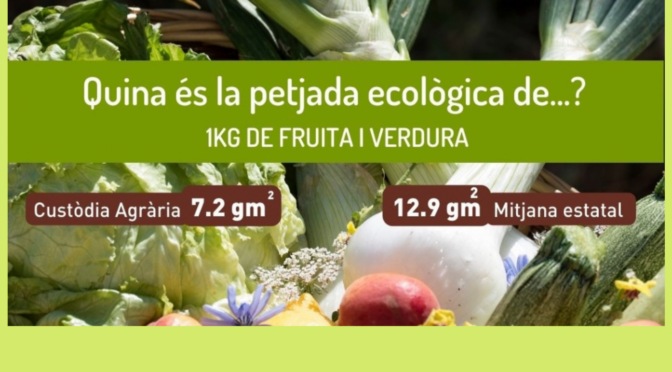
Just three months ago on 29 July, we entered a global ecological deficit. It was called the Earth Overshoot Day 2021. That means that all the resources that we have consumed in the world since that date cannot be regenerated and we are going into the accumulated natural reserves that are diminishing at an alarming rate. It also refers to the pollution produced that cannot now be absorbed into the biosphere.
That organisation that annually calculates when Overshoot Day is reached has chosen 100 initiatives for the entire world that can help delay the date. The solution that they proposed is one that we promote from GOB: the Land Stewardship Scheme.
Specifically, a study has been done on the ecological footprint from the production of beef in the Land Stewardship Farms. They have taken into account factors such as the type of food given to the cattle – if produced on the same farm or, if imported, the distance covered; if the cows are out to pasture or are in cattle sheds etc; the energy resources consumed by the farms – electricity, fuel- and the use of fertilizers amongst other things.
The result has been that the production of beef on Land Stewardship Scheme farms has an ecological footprint up to 64% less than the national average. This is a really significant difference that comes from two factors.
The first factor is the resources consumed with each type of production and the associated pollution. To produce a kilo of beef from the Land Stewardship Scheme requires 15% less in financial resources than that required by conventionally produced meat. This contradicts the theory that to produce organic meat extensively is more costly than by intensive farming.
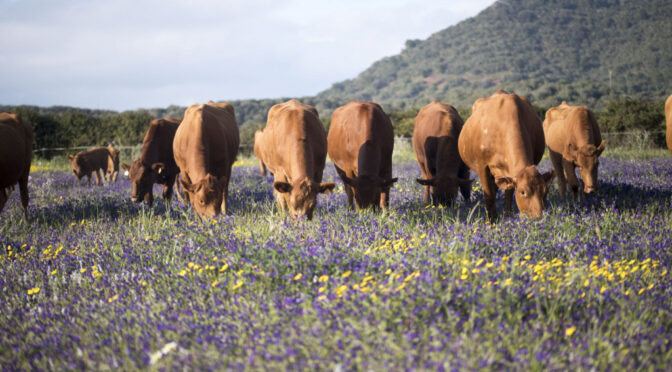
The second factor is the Land Stewardship Scheme itself. It is that much of the land for the Land Stewardship Scheme would not be considered by conventional farming as giving optimal production value. Land Stewardship farms take advantage of the mosaic landscape that combines cultivated land with areas of wild vegetation for agricultural production. The livestock eats partly from wild pasture roaming through wooded areas and scrubland. Furthermore, this type of management does not deplete the biodiversity but rather encourages it.
In this way, the consequence is not only the kilo of meat that is produced but also there are additional positive results such as the capture of carbon coming from the vegetation of the managed areas.
As consumers, all of us have the possibility to encourage the type of food that respects the ability of regenerating the World. Bear this in mind when you go shopping.
You can consult the available products of the Land Stewardship Scheme sold direct on https://www.gobmenorca.com/productescustodia. You can learn more about the program by watching the videos listed on our You Tube Channel.
You can see news on the Global Footprint network website.
The calculation of the ecological footprint for the production of beef has been possible thanks to the economic support of the MAVA Foundation within the Foodnected project.