
Views: 64
It is difficult to get people who are spending a few days on holiday to understand that the place they are visiting has water problems. Perhaps they could get an idea if the surrounding context suggested it, but that is not the case.
The progressive loss of drinking water in Menorca is directly related to the economic development model that is being promoted. The resident population is making efforts to reduce consumption, but spending is increasing in tourist areas.
On Saturday, June 13, at 7:30 p.m., a protest action has been called in Biosphere Square in Maó. A great deal is at stake for the immediate future. Please help spread the call.
Less water consumption in traditional town centres, but more in urban developments
The latest figures published on the evolution of aquifers in Menorca and their management show one positive aspect and one negative one. On the positive side, it can be confirmed that the resident population has learned to act in a more responsible way with water. Indeed, consumption in traditional town centres is decreasing.
On the other hand, consumption in urban developments continues to increase. This is due to two reasons. On the one hand, it should be noted that public spending on tourism promotion increases every year.
Let us remember that the island has seen the number of tourists increase by approximately 80% over the last 15 years.
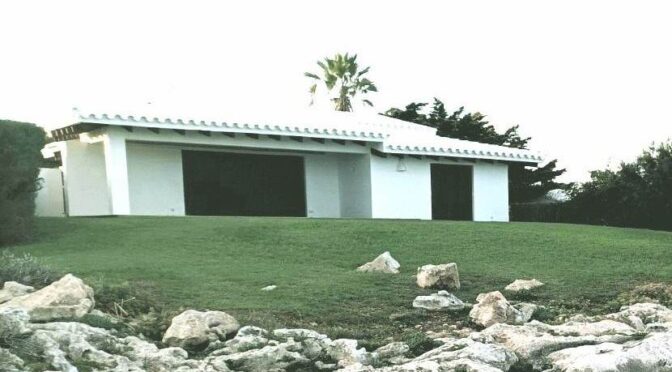
But the environment typically found in Menorcan urban developments also has an influence. Surrounded by swimming pools and gardens with extensive green lawns in the middle of summer, the last thing a tourist is likely to think is that Menorca has water problems.
The island needs to gradually change the configuration of tourist areas in order to improve their environmental coherence with the place where they are located.
Tourist consumption
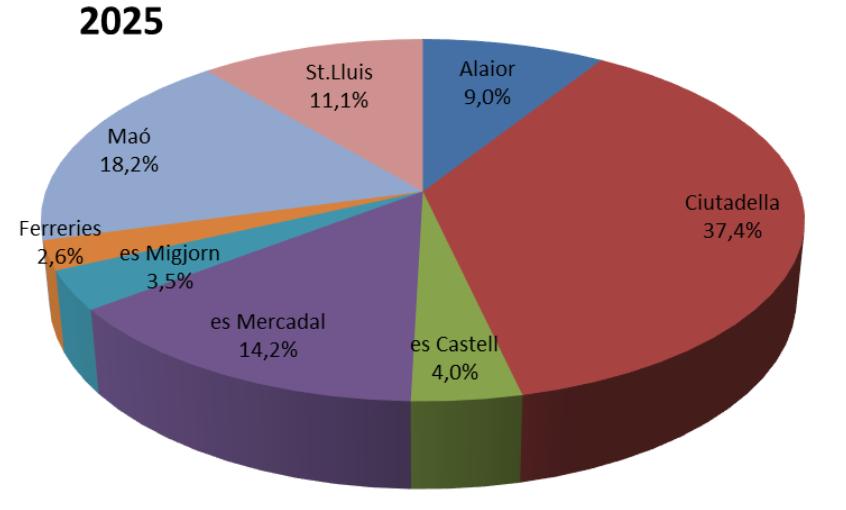
Not all municipalities have the same tourist load. But those with more urban development clearly show it on the water meters. Ciutadella has a resident population similar to that of Maó (around 30,000 people), but it uses 100% more water than the eastern part of the island.
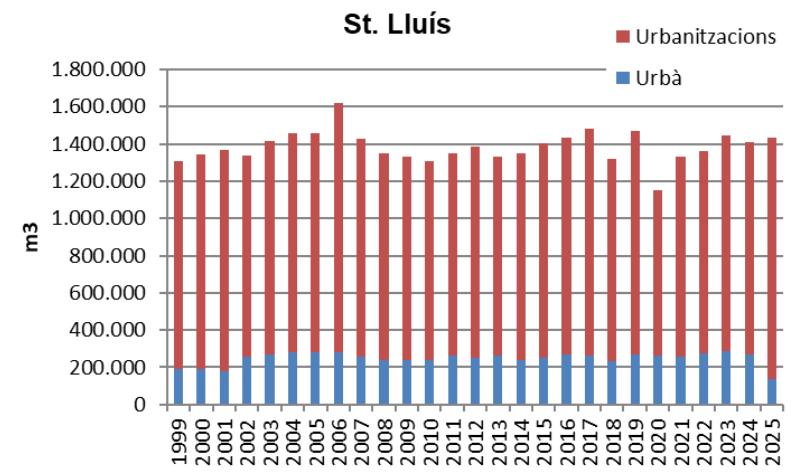
In Migjorn, the coastal area uses more than 60% of the water consumed. In Sant Lluís, urban developments account for almost 90% of water consumption.
At island level, urban developments house around 18% of the population but represent more than 45% of water consumption.
Swimming pools, gardens, rental cars
As mentioned at the beginning, it is common for a tourist to have a higher level of consumption than a resident. This is normal because habits while on holiday are not the same (for example, there are usually more daily showers), but there are other elements associated with tourism that significantly add to the problem.
In Menorca there are almost 11,000 swimming pools, the highest percentage per inhabitant known at state level in Spain. The water implications in terms of evaporation, losses, filter cleaning, etc., become significant when multiplied by so many thousands.
The gardens commonly found in many coastal urban developments, which reproduce models typical of northern regions, with large expanses of green lawn in summer, usually require between 5 and 8 times more water than homes located in traditional town centres.
In addition, there is the water used to clean tourist rental vehicles. Two studies have been carried out on vehicles in Menorca. The one from 2023 estimated between 10,000 and 15,000 rental vehicles. The one from 2025 estimated between 9,000 and 13,000 vehicles. Taking around 12,000 rental cars as a reference therefore seems fairly accurate.
Applying the estimated litres per regular wash, the rental car fleet would approach 100 million litres over the four main summer months (100,000 tonnes). To this we must also add the water consumption derived from the thousands of private vehicles transported by the ships bringing people on holiday.
Let’s make the springs flow again
In recent decades, Menorca has seen many springs dry up. This is the consequence of the progressive lowering of aquifers. How water management on the island is addressed will determine whether springs will flow again in Menorca someday or whether we resign ourselves to following the same path as Ibiza, which already has three desalination plants and is now processing a fourth, which, as expected, is presented as the definitive solution.
Menorca needs to continue promoting responsible water management policies. It is necessary to set limits on tourism growth, put residents’ needs first, control extractions for large-scale irrigation and reduce losses in the networks of some municipalities. To recover the philosophy of the Biosphere Reserve, where the goal is not to be able to say that more tourists have arrived or that more houses have been sold, but that the living conditions of the population have improved.
Water in Menorca is another key issue in the Via Menorca campaign. A problem that also brings us together on June 13 in Biosphere Square in Maó. Please help spread the call.