
Views: 18
The world is drifting off course for two main reasons. On the one hand, there are those who fail to understand that the planet is finite. On the other, there are those who constantly spread pessimism. To make our way between the two, we need inspiration (hope), organisation (capacity) and a timetable (perseverance).
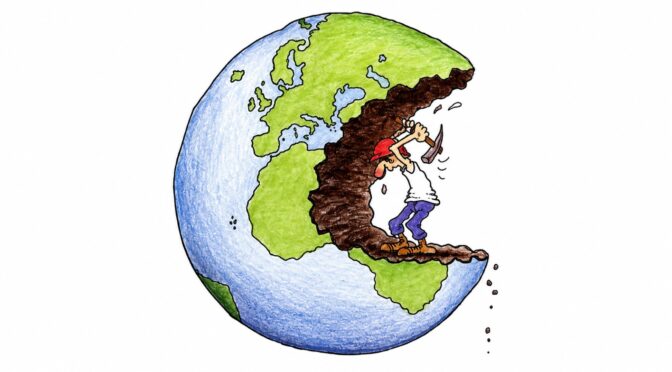
In today’s society, flat-earthers are not the majority. The majority are infinitists: people who believe we live in a world without limits. That is why they celebrate the usual indicators of ever-growing consumption.
Without accepting that the planet is finite, a society based on permanent growth inevitably creates major environmental impacts, which ultimately lead to profound inequalities and enormous imbalances.
Climate change, warned about for decades, is already here. It affects crops, cities and schools. The depletion of aquifers, announced in every possible way, has already arrived. It affects people, wildlife and landscapes. The growing waste crisis, fuelled by the refusal to recycle, threatens to overwhelm the island’s landfill within just a few years.
When faced with these problems, infinitists usually adopt one of two strategies: deny the problem or promote solutions that create new environmental challenges. They may claim that climate change is a conspiracy or blame solar panels instead. Their preferred solution is often nuclear power, with radioactive waste lasting thousands of years and an industry dominated by the very same companies that have long controlled fossil fuels.
They may insist there is no water shortage because it has rained a lot. This form of denial is also practised by the Balearic Government when it removes the requirement for water sufficiency studies in certain urban developments. Their proposal is desalination plants, which require energy, produce brine and depend on major public infrastructure to connect to distribution systems. Remarkably, this is far more expensive than using groundwater resources more rationally.
They resist separating waste to increase recycling. They argue that placing rubbish bags inside sealed bins encourages more rats than leaving them directly on the street or in overflowing containers. Their solution is incineration, despite its risks of serious air pollution and extremely high economic costs. Ibiza, for example, has chosen to transport all of its waste to Mallorca’s incinerator.
Alongside these misguided infinitists are, as mentioned at the beginning, those who recognise the seriousness of the situation but respond with defeatism. Sometimes this comes from genuine conviction; at other times, it becomes a way of avoiding involvement. “Nothing will make a difference.” “It’s already too late.” “Everything is lost.” “There’s no point.”
That is why we must appeal to citizens who refuse to accept decline with resignation. There are people who feel a responsibility towards the living world around them and towards the legacy they leave to future generations. There are alternatives, but they are too often held back by the short-term interests of a few.
Because passing through this world is a richer experience when we are connected to its beauty.
Because trying is worthwhile.
Because once we accept that the world is finite, we care for it more.
Because when people combine the three ingredients mentioned at the beginning—hope, organisation and perseverance—many things improve.
(This text is an adaptation of the original article published by Miquel Camps, as coordinator of territorial policy for the GOB, in the Menorca newspaper on 20/07/2026).